
 others

Why Choose Us
- ⚡Fast 7-day turnaround
- 🎨Free design assistance
- 📦No minimum order quantity
- ♻️Eco-friendly materials available
- ✅100% satisfaction guarantee
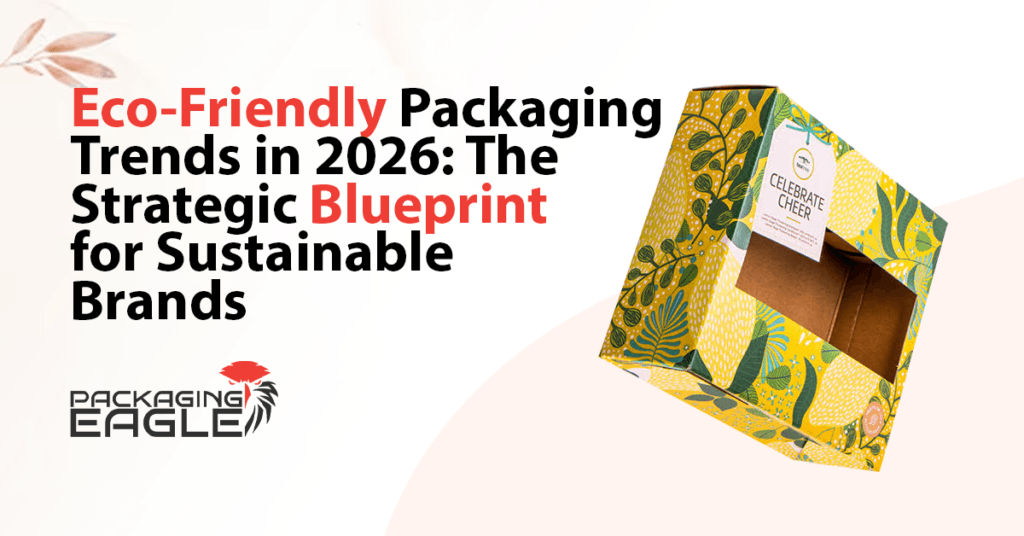
Eco-Friendly Packaging Trends in 2026: The Strategic Blueprint for Sustainable Brands
Eco-friendly packaging trends 2026 are changing how businesses make, pack, and deliver their products. A box that looks good on a shelf may still create problems after a customer throws it away. And that is something more buyers and businesses are starting to pay attention to.
The real challenge is finding packaging that protects products, keeps costs under control, and creates less waste. Hence, brands are turning to recycled materials, paper-based packaging, right sizes, mono-material designs and refill systems. However, which one of these changes makes sense to make and what should businesses take into account before changing?
We will examine packaging trends, discuss their applicability and their relevance to your product, budget, and customers, and provide an outlook on selecting options that make sense for you in 2026. You can also read how to choose the right packaging for your product for more guidance.
Why Sustainable Packaging Matters in 2026
Excessive packaging contributes to waste and over shipping; inadequate packaging can result in damaged products. Source, make, distribute, protect and recover.
The EU Packaging and Packaging Waste Regulation became applicable to all packaging in general on 12 August 2026 and covers packaging design, packaging waste prevention, recyclability, re-use and labeling. Rules vary market to market so you need to check out the rules for each market.
The Biggest Eco-Friendly Packaging Trends in 2026
Packaging is heading toward materials and designs that use less, waste less and are easier to recycle, all while maintaining product protection and business costs.
1. Recycled and Post-Consumer Materials
Brands are looking at packaging materials that are recyclable. Post-consumer recycled (PCR) is material derived from used consumer products. This is because there are variations in supply, quality, strength, and price.
Inquire of suppliers for documentation of percentages of recycled content and pre- or post-consumer content. Test and review food contact regulations. Check any FSC certification and actual product claim. Browse our eco-friendly boxes for recycled options.
2. Paper-Based and Fiber-Based Packaging
Cartons, shipping boxes and inserts are made from paperboard, kraft, corrugated cardboard and molded fiber. For shelf products, custom retail boxes can be specified by size, board grade, and construction. Explore our custom cardboard boxes and custom corrugated boxes as well.
Fiber is not automatically lower impact or recyclable everywhere. Coatings, inks, adhesives, sourcing, and local collection matter. Plastic-free packaging also needs a full check: include seals, windows, labels, and adhesives before making that claim.
3. Right-Sized and Lightweight Packaging
Packaging waste reduction includes both source reduction and “right sizing.” Boxes are too big, require additional void fill and space for storage. Check order sizes and minimise space around empty orders.
Lightweighting may result in reduced material consumption but check the package first. A weaker box may lead to losses from breakage or returns, which may lead overall to more waste. Custom mailer boxes for online orders should be evaluated for fit of the product, stacking, handling and shipping requirements.
4. Mono-Material Design and Easier Recycling
Mono-material packaging involves using one primary material for the majority of the packaging and this can make it easier to sort. Local facilities must accept it, and coatings, closures, labels, and adhesives still matter.
Check the recycling infrastructure where customers live. “Technically recyclable” does not mean a package is collected and processed in every community. Good design for recyclability considers sorting and material recovery after use.
5. Reusable, Refillable, and Circular Packaging
Products that are frequently bought again may be suitable for re-usable packaging and refill systems. They need good and amply containers, good and easy to return containers, cleaning, reverse logistics and appropriate re-use cycles. Reusable formats such as collapsible rigid boxes are worth a look, and you can read why luxury brands choose collapsible rigid packaging.
Retaining packaging in use is one of the components of circular packaging and is a way to lower the need for new resources. Must be able to accept refills and collections. Do not presume reuse has a lower impact without measuring return rates & transport.
6. Compostable and Biodegradable Materials
Compostable packaging is not biodegradable packaging. Biodegradable means that it can be broken down by biological processes under certain conditions, but this does not guarantee a rapid or non-toxic breakdown in the environment. Compostable materials are required to meet a number of conditions and standards. Some need industrial composting and are not suitable for home compost.
Check whether local composting facilities accept the exact item. The US EPA cautions that compostable plastics should not go into ordinary plastic recycling. If no suitable facility is available, then another material may be more sensible.
7. Better Information and Supply-Chain Transparency
Clear labels, QR codes can tell you how to dispose of it and what it’s made of. Supplier information can help bring transparency to the supply chain, but a QR code is not sufficient to make packaging sustainable.
A life cycle assessment (LCA) is an assessment which can be used to compare impacts over the entire life cycle of product, including sourcing, production, transport, use, and disposal. Consider the carbon footprint alongside product protection and waste, rather than judging a package by colour or one material claim.
How to Choose Sustainable Packaging Solutions
No single environmentally friendly packaging option works for every product:
| Material or format | Possible use | Check before choosing |
|---|---|---|
| Recycled paperboard | Retail cartons | Recycled content, strength, coatings |
| Kraft or corrugated board | Bags, boxes, shipping | Sourcing, grade, local recovery |
| Molded fiber | Inserts and protective forms | Fit, moisture needs, local acceptance |
| Reusable containers | Repeat-purchase products | Returns, cleaning, reuse cycles |
| Compostable material | Suitable food or product uses | Standard, facility access, disposal route |
For sustainable custom packaging, check protection, availability, dimensions, printing, shipping, cost, and disposal. Eco-friendly retail packaging needs shelf strength; sustainable e-commerce packaging must handle sorting and delivery. For paper bags, see our custom shopping bags.
How to Build a Practical Packaging Plan
Analyze every component, material, weight, dimension, source and need. Look for over-filled boxes or excess layers, and set measurable objectives for decreasing the amount of space or increasing the amount of verified recycled content.
Request samples and test reports from suppliers using shipping and storage conditions. Test the change and record results, returns, material use, feedback and cost. You can also check extended producer responsibility (EPR) and local packaging regulations. Compare formats in types of packaging and which one suits your business best.
Mistakes to Avoid
Avoid broad claims such as “100% eco-friendly” or “zero impact.” The FTC Green Guides say environmental claims need clear support and qualifications where necessary. This is important when talking about “recyclability,” “recycled content,” and “refillability.”
Avoid using the terms “biodegradable” and “compostable” interchangeably, avoid collecting locally, and do not take away essential protection. These errors can confuse the customer and exacerbate damages. Avoiding greenwashing is assisted through evidence.
Make Your Next Packaging Decision Count
The best sustainable packaging options are those that work well with your product manufacturing, selling, shipping and disposal practices. Analyze existing materials, establish a clear objective, pilot changes and expand to scale. At Packaging Eagle, we can provide you with sustainable packaging such as custom kraft boxes and other custom printed packaging solutions, depending on your product, dimensions, quantity and shipping requirements. Read the complete guide to kraft packaging to learn more. A measured approach gives you a better basis for reducing waste and making claims you can support.

Custom Quote
Ready to Elevate Your Packaging?
Fill out the form — our team responds within 24 hours with a free quote.
Why Choose Us
- ⚡Fast 7-day turnaround
- 🎨Free design assistance
- 📦No minimum order quantity
- ♻️Eco-friendly materials available
- ✅100% satisfaction guarantee
Table of Contents
Frequently Asked Questions
Our custom packaging services help your brand stand out with tailored boxes, eco-friendly materials, and high-quality printing. We offer exact sizing, fast production, and distinct finishes to fit your products.
How can I order?
The ordering process is as easy as 1-2-3 with us! Directly call us directly or reach us via the quote form. We are available 24/7 to help you through the whole process.
Do you offer eco-friendly materials for these boxes?
We offer recyclable materials for these boxes to make the Earth green and protect its environment.
Can packaging boxes be printed on both sides?
Definitely! We give you full liberty to print the packaging from inside/out or both sides to enhance the visual appeal and give an unforgettable experience while unboxing.
Do you offer these boxes with inserts?
Of course! Get an array of insert options, from foam to cardboard inserts, with us to hold the products in place in the packaging during storage and transit.
Do I get your packaging with free shipping?
We offer free shipping of the ordered packaging all over the USA within the given time frame.
Do you offer free shipping for custom boxes in bulk?
We offer shipping to our valuable clients within the set timeframe without additional cost. Just share the address, and we will handle the rest.
Related Posts