
 others


Why Choose Us
- ⚡Fast 7-day turnaround
- 🎨Free design assistance
- 📦No minimum order quantity
- ♻️Eco-friendly materials available
- ✅100% satisfaction guarantee
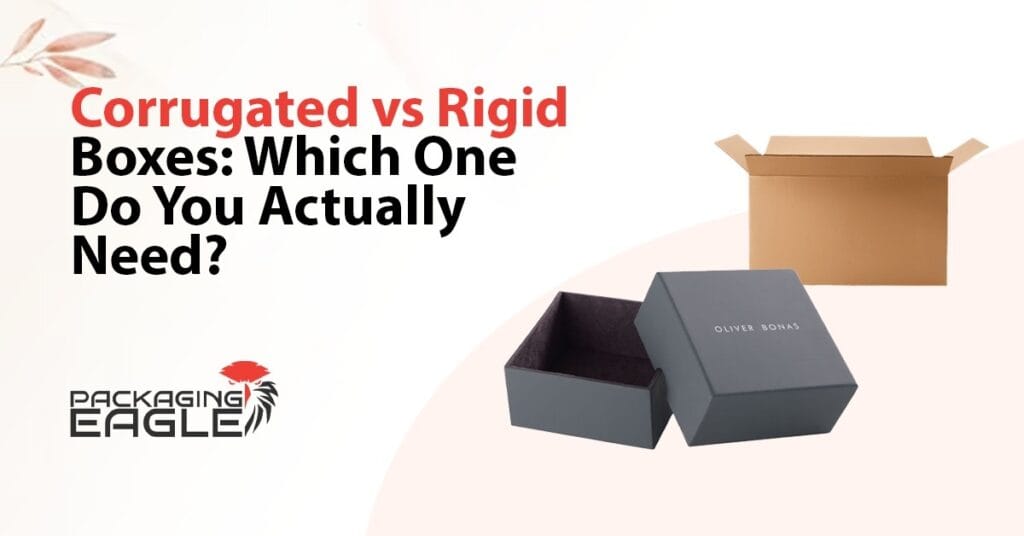
Corrugated vs Rigid Boxes: Which One Do You Actually Need?
Are you looking for packaging that can survive long-distance shipping, or a box that gives your product a premium look on store shelves? These two needs may call for very different packaging materials.
If you’re comparing corrugated vs rigid boxes, you must consider more than just looks. You would like to know how effectively each box does its job, what it costs, and where each is best used. In this blog, you’ll learn how the two options differ so you can decide on the one that fits your product, budget, and sales requirements.
What Are Corrugated Boxes?
Corrugated boxes are manufactured using a wavy layer of paper between flat sheets called linerboard. The wavy layer is referred to as fluting. It absorbs impact and pressure and leaves space between the liners.
There are various types of corrugated board, depending on the type of flute and the construction of the board. Single wall board has one fluted layer between two liners. Double wall board is made of two fluted layers with three linerboards. The choice depends on the weight and size of the product, stacking, and shipping conditions.
Such boxes are often used in e-commerce shipping, retail supply chains, and warehouses. Businesses use them for online orders, subscription packages, wholesale cartons, and bulk deliveries. They can also have printed designs, dividers, and product inserts to help organize products. Many varieties of corrugated boxes ship flat and are assembled as needed. This reduces the need for extra storage space, especially if orders are made often.
What Are Rigid Boxes?
Thick greyboard or chipboard is used as the basic material of custom rigid boxes. The board is cut and built up into a sturdy form and decorated with printed paper, textured paper, fabric, or other finishes.
These boxes are often used for products that require a high-quality look. Jewelry, watches, perfumes, custom cosmetic boxes, electronics, and custom gift packaging are a few examples.
The lid-and-base box is a well-known rigid box form. Other popular types include magnetic closure boxes and drawer-style boxes. Foam, paperboard, or fabric-lined inserts can be added to keep products in place. The outer design offers additional options with foil stamping, embossing, debossing, and matte lamination finishes.
The firm structure supports the shape of the box. However, conventional rigid boxes typically consume more space because they are normally delivered assembled. For companies that require less storage space, collapsible rigid boxes are also available.
Corrugated vs Rigid Boxes: Key Differences
The starting point in the difference between corrugated and rigid boxes is the construction. Corrugated board is used for cushioning and support in shipment because of the fluting. Rigid packaging has a thick paperboard core that provides a firm framework.
To get an idea of the difference between these two packaging boxes, here’s a quick comparison.
| Feature | Corrugated Boxes | Rigid Boxes |
|---|---|---|
| Construction | Fluted board between linerboards | Thick greyboard or chipboard wrapped in paper |
| Main purpose | Shipping, stacking, and transit protection | Product presentation and gifting |
| Appearance | Plain, printed, or branded | Decorative wraps and premium finishes |
| Protection | Cushioning and stacking support | Firm walls and support from inserts |
| Storage | Many styles ship flat | Traditional styles usually arrive assembled |
| Customization | Printing, dividers, and inserts | Specialty paper, foil, embossing, and inserts |
| Common uses | E-commerce, wholesale, and subscription orders | Jewelry, cosmetics, electronics, and gifts |
Neither option is necessarily better or cheaper. Performance will vary depending on the board grade, box size, box construction, and how the package will be handled.
A well-designed double wall corrugated box can give good protection to a heavy shipment, for instance. A rigid box with a well-fitting insert will keep a delicate product secure, but it might require an outer shipping carton.
When Should You Choose Corrugated Boxes?
Corrugated boxes are versatile and can be used for a wide variety of purposes. When products must travel through delivery routes, warehouses, and stores, corrugated packaging makes sense. Its structure gives good cushioning, and depending on the type of board, it may also offer good crush resistance and stacking strength.
Here are a few situations where corrugated boxes are appropriate:
- Shipping or e-commerce deliveries
- Bulk orders and warehouse stacking
- Monthly subscription boxes
- Protection of heavy products and fragile goods like glassware or electronics
You can choose from different flute profiles, wall constructions, printing options, and dimensions with custom corrugated boxes. These decisions help align packaging with real shipping conditions.
When Should You Choose Rigid Boxes?
Rigid boxes are ideal for a sophisticated retail presentation or for gifts. They have thick walls that make them sturdy, and businesses can also add colors, textures, and printed designs to them.
Common applications include:
- Jewelry and watches
- Luxury custom cosmetic boxes and skin care
- Electronics
- Premium custom retail boxes
These premium product packaging boxes can also be beneficial for brands that want customers to keep the packaging after they have opened it. For instance, a jewelry box can later be used for holding rings, earrings, or other small jewelry pieces.
Specialty materials and finishes will impact the final cost. The production requirements include specialty paper, extra inserts, magnetic closures, and detailed printing. These factors should be taken into account when businesses make their packaging budget plans.
Can You Use Both Corrugated and Rigid Packaging?
Yes. Some products require a presentation box and an outer package to be delivered. Using both types is a practical way to handle these requirements.
For example, a perfume brand can place its bottle inside a rigid box with a fitted insert. That box can then go inside a corrugated shipping carton with suitable protective material around it.
The rigid box handles the retail presentation and protects the product inside its fitted space. The outer corrugated carton protects the entire package during transit.
This is especially helpful for online sales of luxury goods, electronics, gift sets, and fragile products.
How to Choose the Right Box for Your Product
Check how the product will be stored, sold, and delivered before choosing a box. A few questions can help to narrow down your options:
- What is the weight of the product? Heavy products may require a higher-quality board or extra support.
- Could the product crack or be scratched? Think of inserts, dividers, and protective padding.
- Will it be shipped on a regular basis? Check delivery distances, stacking, and handling.
- Will it be in the hands of consumers on a retail shelf? Consider the finish, opening, and overall presentation.
- How much storage capacity do you have? Flat-packed boxes can help lower the amount of warehouse space needed.
- How much does it cost to package all the items? Cover materials, printing, inserts, assembly, storage, and shipping.
It’s also better to test a sample with the product itself. Test for fit, box closing, and handling performance. A packaging sample can identify issues before you order larger quantities.
Final Thoughts
When deciding between corrugated vs rigid packaging, you’ll want to consider what your product requires. Corrugated boxes are great for shipping and storage, while rigid boxes are made for high-end presentation and gifting. Some products can benefit from both. Take the entire packaging need into account when deciding.
You can contact our team at Packaging Eagle to talk about your product, material, box style, and printing needs. We can assist you in comparing custom rigid boxes against corrugated boxes and help you determine which is appropriate for your business. Get a quote to discuss your project.
Custom Quote
Ready to Elevate Your Packaging?
Fill out the form — our team responds within 24 hours with a free quote.
Why Choose Us
- ⚡Fast 7-day turnaround
- 🎨Free design assistance
- 📦No minimum order quantity
- ♻️Eco-friendly materials available
- ✅100% satisfaction guarantee
Table of Contents
FAQs
Frequently Asked Questions
Our custom packaging services help your brand stand out with tailored boxes, eco-friendly materials, and high-quality printing. We offer exact sizing, fast production, and distinct finishes to fit your products.
How can I order?
The ordering process is as easy as 1-2-3 with us! Directly call us directly or reach us via the quote form. We are available 24/7 to help you through the whole process.
Do you offer eco-friendly materials for these boxes?
We offer recyclable materials for these boxes to make the Earth green and protect its environment.
Can packaging boxes be printed on both sides?
Definitely! We give you full liberty to print the packaging from inside/out or both sides to enhance the visual appeal and give an unforgettable experience while unboxing.
Do you offer these boxes with inserts?
Of course! Get an array of insert options, from foam to cardboard inserts, with us to hold the products in place in the packaging during storage and transit.
Do I get your packaging with free shipping?
We offer free shipping of the ordered packaging all over the USA within the given time frame.
Do you offer free shipping for custom boxes in bulk?
We offer shipping to our valuable clients within the set timeframe without additional cost. Just share the address, and we will handle the rest.
Related Posts