
 others


Why Choose Us
- ⚡Fast 7-day turnaround
- 🎨Free design assistance
- 📦No minimum order quantity
- ♻️Eco-friendly materials available
- ✅100% satisfaction guarantee
Length Width Height Dimensions: Step-by-Step Guide
Ever measured a box and not known whether you measured length, width and height correctly? It’s a very common occurrence, particularly when there is a resemblance between all three sides. This can result in incorrect box size, packaging problems, or additional shipping charges. Understanding the length width height dimensions will enable you to take a proper measurement the first time. This step-by-step guide will tell you where each side should be measured, how the numbers should be recorded and what to check before using your measurements. You can also read how to choose the right packaging for your product.
What Do Length, Width, and Height Mean?
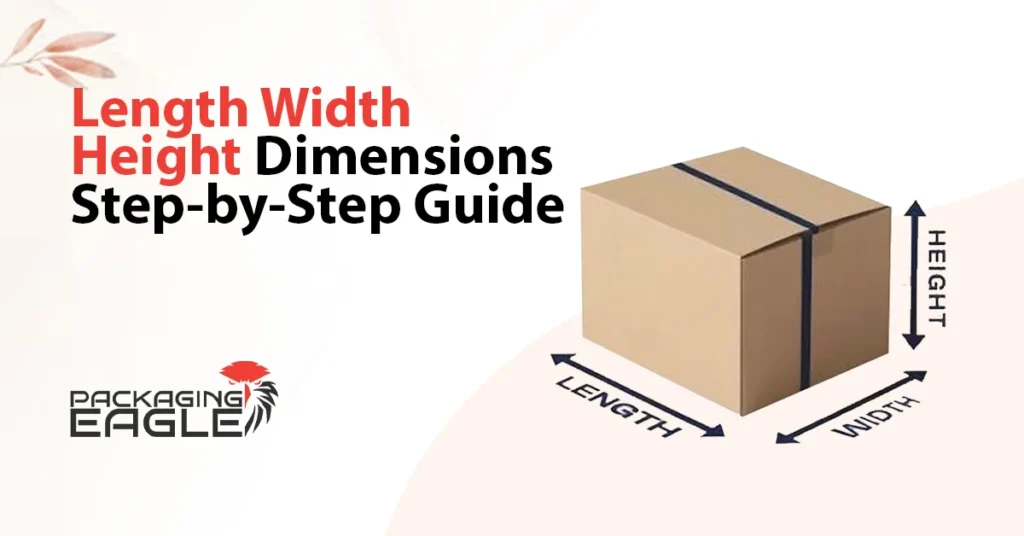
Length, width and height are the three dimensions that describe an object. They are usually recorded as L × W × H.
What Is Length?
The longer horizontal side of a rectangular product or box opening is usually referred to as length. Maintain the same orientation when taking measurements.
What Is Width?
The other horizontal measurement, taken at right angles to the length is called width. It is usually the short side of a rectangle opening.
What Is Height?
It is a vertical dimension from bottom to top in the item’s intended position. On a box, it runs from the base to the opening. Some suppliers call it depth, so confirm their terminology.
What If the Product Is Not Rectangular?
Not every product has flat, even sides. A bottle, soft pouch, curved item, or irregular shape needs a different approach. Measure the greatest length, widest point, and highest point while keeping the product in its intended packing position.
For products with handles, corners, or delicate projections, note where those parts sit and tell the supplier. A simple set of L × W × H numbers may not be enough to plan a shaped insert or a close-fitting package. A product drawing, photograph, or physical sample can help explain the shape. Review the sample packaging with the item before approving the final production run.
How to Measure Length, Width, and Height Step by Step
On a flat surface, take a tape or ruler:
- Place the product in the proper location. Place it in the position it will be in the package.
- Identify the length. Select the side, horizontal side, that is labeled length. In the case of a rectangular object, it is the larger side.
- Measure the length. Measure straight from one outer edge to the opposite edge.
- Measure the width. Measure the other horizontal side, perpendicular to length.
- Measure the height. Measure from the bottom to the highest point, including fixed parts that must fit inside the box.
- Record the units. Record all three in inches or millimeters; do not mix units.
- Check the results. Repeat the measurements and note uneven edges or fragile parts.
A rectangular product, for instance, might be 8 inches long, 5 inches wide, and 3 inches high. Record its L × W × H dimensions as 8 × 5 × 3 inches.
How to Measure a Box for Packaging
Place the assembled box on a level surface. Measure the two sides of the opening, then measure from the inside base to the top opening if you need usable internal space.
A box measuring 14 × 10 × 6 inches is 14 inches long, 10 inches wide, and 6 inches high. Check whether these box dimensions are internal or external; suppliers may request either.
Box style matters too. Mailers, folding cartons and rigid boxes are constructed differently. When you design custom box dimensions, inform the supplier about the product and any inserts or cushioning. E-commerce sellers may want to consider custom mailer boxes, while premium products suit custom rigid boxes. Browse more custom box styles.
Internal vs. External Box Dimensions
The size of the space inside a box is called the internal dimensions. They assist in determining fit of the product, inserts and protective materials.
External dimensions are the dimensions of the package as it comes out of the machine. They can be used for shipping calculations, inventory, and if cartons will fit in a warehouse shelf or pallet.
The two sets of measurements are different because of the board thickness, folds and seams. Outside dimensions do not exactly reflect the amount of space available within the box.
If you are asking for a quote make sure your measurements are clearly marked. Internal measurements for product fit. External measurements may be required for shipping and storage.
Example: Measuring a Product for a Custom Box
Imagine a product measuring 8 × 5 × 3 inches. These are product measurements, not automatically the correct box size.
An insert takes up internal space. Cushioning may also be needed around fragile areas. The required size depends on the insert, product shape, material, and box construction.
Give your supplier the measurements and protection requirements. Test a sample with the actual product and insert before approving production.
How Much Extra Space Should You Leave Inside a Box?
There is no universal clearance allowance. Glass may need cushioning around its sides and base, while a flexible product may need less. Insert design and product position also affect the space required.
Don’t add an arbitrary amount. Consider the insert and cushioning. Try a sample to see if it moves without pressing on the product.
Common Measurement Mistakes to Avoid
Before ordering, make sure you know these things:
- Combining units: Record length, width and height in a single unit.
- Ordering the measurements: Order measurements as per your supplier/carrier.
- For measuring diagonally: Use the tape or ruler straight along each side.
- Include fixed protrusions (handles, caps or anything that has to fit inside).
- Mixing inside and outside sizes: Make sure to label sizing as internal/external.
- Not considering material thickness: Board thickness is important because it will give an error between the thickness of the board and the final box size.
- Misoriented: Measure the product in the position in which it is to be packed.
Why Accurate Dimensions Matter for Shipping and Packaging Costs
Shipping and packaging costs are often a significant portion of the logistics budget. Shipping and packaging costs are potentially a major cost in the logistics budget.
Properly sized shipping boxes will minimize space wastage and reduce product damage. Too large cartons create excess material and void fill, too small boxes can have no protection space. See custom boxes vs. stock boxes to compare costs.
Carriers can employ dimensional weight (DIM weight), which takes into account package volume as well as actual weight. Divisors and billable-weight rules vary by carrier, service, and destination.
For retail products, custom retail boxes can be sized around the item. For shipping, custom corrugated boxes may provide the needed board strength. Confirm the use and dimensions before production. Learn more in types of packaging and which one suits your business best.
Choose Packaging That Fits Your Product
Take the product measurement in packing position, record L x W x H with consistency and determine if internal or external measurement is required. Allow for protection and inserts.
Our team at Packaging Eagle can assist you in your custom packaging planning based on a product’s size, style of box, material, and quantity of boxes. Give your measurements and needs to discuss a possibility and quote.
Custom Quote
Ready to Elevate Your Packaging?
Fill out the form — our team responds within 24 hours with a free quote.
Why Choose Us
- ⚡Fast 7-day turnaround
- 🎨Free design assistance
- 📦No minimum order quantity
- ♻️Eco-friendly materials available
- ✅100% satisfaction guarantee
Table of Contents
FAQs
Frequently Asked Questions
Our custom packaging services help your brand stand out with tailored boxes, eco-friendly materials, and high-quality printing. We offer exact sizing, fast production, and distinct finishes to fit your products.
How can I order?
The ordering process is as easy as 1-2-3 with us! Directly call us directly or reach us via the quote form. We are available 24/7 to help you through the whole process.
Do you offer eco-friendly materials for these boxes?
We offer recyclable materials for these boxes to make the Earth green and protect its environment.
Can packaging boxes be printed on both sides?
Definitely! We give you full liberty to print the packaging from inside/out or both sides to enhance the visual appeal and give an unforgettable experience while unboxing.
Do you offer these boxes with inserts?
Of course! Get an array of insert options, from foam to cardboard inserts, with us to hold the products in place in the packaging during storage and transit.
Do I get your packaging with free shipping?
We offer free shipping of the ordered packaging all over the USA within the given time frame.
Do you offer free shipping for custom boxes in bulk?
We offer shipping to our valuable clients within the set timeframe without additional cost. Just share the address, and we will handle the rest.
Related Posts