
 others

Why Choose Us
- ⚡Fast 7-day turnaround
- 🎨Free design assistance
- 📦No minimum order quantity
- ♻️Eco-friendly materials available
- ✅100% satisfaction guarantee
Mylar Bag Sizes Explained: Find the Best Size for Your Product
Selecting the appropriate size packaging is a vital part of presenting, protecting, and shipping a product. A bag that is too tiny can damage the product or make it difficult to seal, while an enormous bag can waste material and make the package look less professional. Mylar bags are popular due to their excellent barrier properties and vast range of sizes and styles.
Choosing the right Mylar bag size can enhance storage, presentation, and usage for whatever you’re packaging, from food and snacks to coffee, vitamins, herbs, and other products.
However, the size of a bag does not always indicate how much product it can hold. The product density, shape, volume, and filling procedure also change the ultimate fit.
This article will walk you through the most popular sizes of Mylar bags, how to measure your product, and what to look for when purchasing a bag.
What is a Mylar Bag?
Mylar bags are flexible packaging bags usually manufactured from polyester film and often paired with other layers for barrier protection. Their strength, flexibility, and capacity to help protect contents from moisture, oxygen, light, and other environmental conditions (depending on construction) are well known.
Due to these qualities, Mylar bags are employed in a wide range of industries. They come in varying thicknesses, closures, styles and sizes to suit different products.
Some bags have resealable zip closures; some are intended to be heat-sealed. Stand-up bag designs are especially popular as they can stand upright on shelves and provide valuable space for branding.
Why Mylar Bag Size is Important
Packaging size may do more than only affect the looks. Properly sized packaging fits the product appropriately and allows sufficient space for sealing and handling.
If a bag is too small, it can be difficult to fill. The product may also put too much pressure on the seams or the closure.
In contrast, a bag that is too big may require more material than needed and may produce unneeded space.
The appropriate size might also make for better shelf presentation. A well-proportioned box appears more professional and can make it easier for buyers to handle and keep your product.
Properly sized bags can also benefit enterprises that ship products with their packaging efficiency. Packaging that fits product dimensions helps eliminate wasted space in shipping cartons, especially when using suitable mailer boxes for shipping.
Popular Mylar Bag Sizes
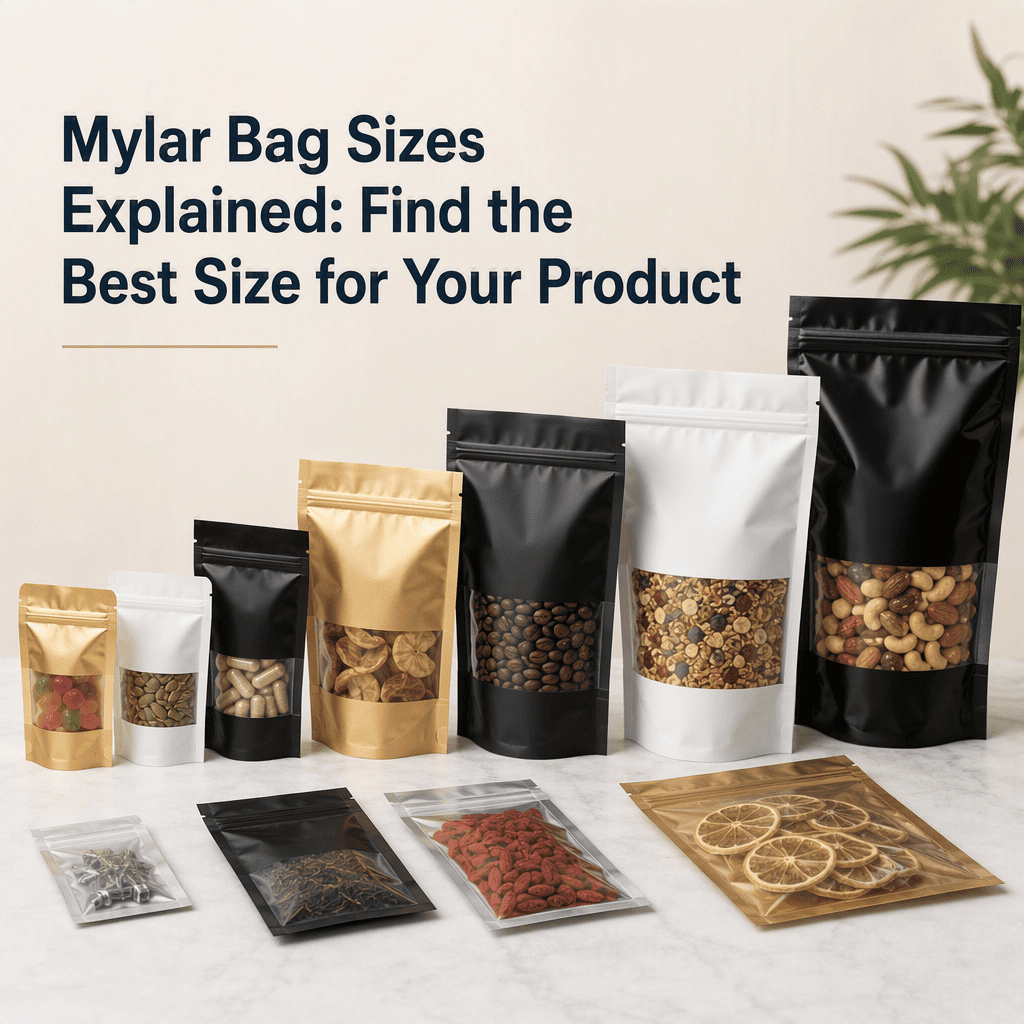
Mylar bags can be found in numerous sizes; therefore, there isn’t one size that fits all for every product. Options range from small bags for single pieces to larger bags for bulk supplies.
Little Mylar Bags
The small bag is good for products that need to be packaged in a compact way. They are suitable for samples, tiny amounts of snack foods, spices, powders, or other light products.
These bags are handy when you need to give away trial-size or single-serving products without a lot of packaging material.
Mylar Bags – Medium
Medium-sized bags provide larger capacity but are still quite easy to keep and manage. They are generally suitable for snacks, coffee, dried foods, pet treats, and similar things.
For retail products, medium bags can provide enough surface area for branding and product information without being overly bulky.
Big Mylar Bags
Large Mylar bags are for products sold in larger quantities. They can be beneficial for bulk food products, larger servings, storage purposes, and things that require greater capacity.
If you decide to buy a larger bag, be sure to pay careful attention to the strength of the material and the quality of the seal, especially if the contents are heavy.
How to Pick the Right Size Mylar Bag
The first step is to know your product. If it is a physical object, measure its length, width, and height. If it is a loose product (grains, powders, snacks, etc.), estimate the approximate volume rather than just physical measurements.
Also, think about how much product you’ll want to fit in the bag. A bag advertised as having a certain capacity may hold more or less depending on the density and form of what is put inside it.
For example, a pound of a heavy product can take up much less room than a pound of a lightweight product. This is why you shouldn’t use weight to calculate the right Mylar bag size.
Leave plenty of area for sealing on top. Overfilling a pouch might affect the zipper or heat seal and may diminish the efficacy of the product overall.
Consider Density and Product Type
One of the most essential aspects in Mylar bag selection is product density. Two products of the same weight can require radically different bag sizes.
Powders, grains, dried fruits, coffee, snacks, and other goods have varying densities and forms. Some items, when put into a pouch, settle naturally, while others hold more air and take up more space.
A good way to get it right is to try out a couple of different bag sizes with a real sample of your product if you are unsure which size to choose.
Consider Packaging Style
Size is only part of the equation. Also consider the Mylar bag style that is most suited for your merchandise.
Stand-up pouches can give a beautiful retail presentation and make products easier to display. Flat pouches are great if you’re short on storage space. Resealable bags provide added convenience for products that consumers use more than once.
The type of closure is important too. A zipper offers an easy way to reseal. If you want a more secure permanent seal, heat sealing might be better.
Printing and Branding Considerations
Mylar bags can also be a significant branding strategy. Once you have decided on the correct size, take into account the area you have for your logo, product name, graphics, instructions, and other information.
Larger bags offer a larger printing surface area; smaller bags need to be more design-focused. Don’t include too much superfluous stuff within the bundle.
A clear hierarchy helps make the product name and key details more noticeable. Consistent colours, typography and visuals may do much to build a recognisable product range.
For businesses using printed packaging across different products, custom printed cardboard boxes can also provide additional branding opportunities.
Summary
When you choose the correct size Mylar bag, you’re looking for more than a bag that can hold a certain weight.
Considerations include product volume, density, shape, filling process, sealing requirements, storage circumstances, and branding demands.
Small bags are good for samples and single servings, while medium and large bags are suitable for larger quantities of product.
The ideal selection is one that has enough space for the product but not superfluous space. For products that require a different packaging format, kraft packaging can also be considered depending on the product and packaging requirements.
Custom Quote
Ready to Elevate Your Packaging?
Fill out the form — our team responds within 24 hours with a free quote.
Why Choose Us
- ⚡Fast 7-day turnaround
- 🎨Free design assistance
- 📦No minimum order quantity
- ♻️Eco-friendly materials available
- ✅100% satisfaction guarantee
Table of Contents
FAQs
Frequently Asked Questions
Our custom packaging services help your brand stand out with tailored boxes, eco-friendly materials, and high-quality printing. We offer exact sizing, fast production, and distinct finishes to fit your products.
How can I order?
The ordering process is as easy as 1-2-3 with us! Directly call us directly or reach us via the quote form. We are available 24/7 to help you through the whole process.
Do you offer eco-friendly materials for these boxes?
We offer recyclable materials for these boxes to make the Earth green and protect its environment.
Can packaging boxes be printed on both sides?
Definitely! We give you full liberty to print the packaging from inside/out or both sides to enhance the visual appeal and give an unforgettable experience while unboxing.
Do you offer these boxes with inserts?
Of course! Get an array of insert options, from foam to cardboard inserts, with us to hold the products in place in the packaging during storage and transit.
Do I get your packaging with free shipping?
We offer free shipping of the ordered packaging all over the USA within the given time frame.
Do you offer free shipping for custom boxes in bulk?
We offer shipping to our valuable clients within the set timeframe without additional cost. Just share the address, and we will handle the rest.
Related Posts